
The Handoff Gap: Why Marketing Works and Revenue Doesn't
When revenue stalls, you might blame marketing. Or even sales. But there are too many variables to make that assumption. And a huge (and super interesting) part of my work is figuring out what's actually going wrong.
I've been meeting with a lot of leaders of professional services firms, and looking at exponentially more firms' online presence. And I've noticed something.
There's a huge gap in the prospect journey. And no one owns it.

The most expensive gap nobody's measuring
A lead visits your site but isn't quite ready to book a call. What happens to them?
You might never know they were there.
If you're slightly more savvy, you've got their IP address. Maybe you have tech that tells you the firm they work for. But you don't know who they are. And if you try to hunt them down with those details, they've never heard of you.
And if marketing does deliver (say a sales leader gets 33 leads and calls each one), what happens next?
It's the most expensive gap in most businesses, and it's completely invisible. Your marketing can be doing everything right. The phone ringing, the traffic climbing, the top of the funnel performing. But because no one explicitly owns the lane between interested and closed, leads slip through the cracks.
Marketing works. The handoff doesn't.
Here's what you're missing: Leaks in the handoff. The space between the click and the call.
Look at the most common version (I can't tell you how many times I have seen this in the last week): a website with exactly one call to action. Book a Call. That works beautifully for the person who's ready right now. But for everyone who's curious, comparing, or not quite there (and that's most of the traffic), there's no next step. No lighter way to raise a hand. So they leave.
That "in-between" space is where the revenue is hiding.
The marketing Venn diagram
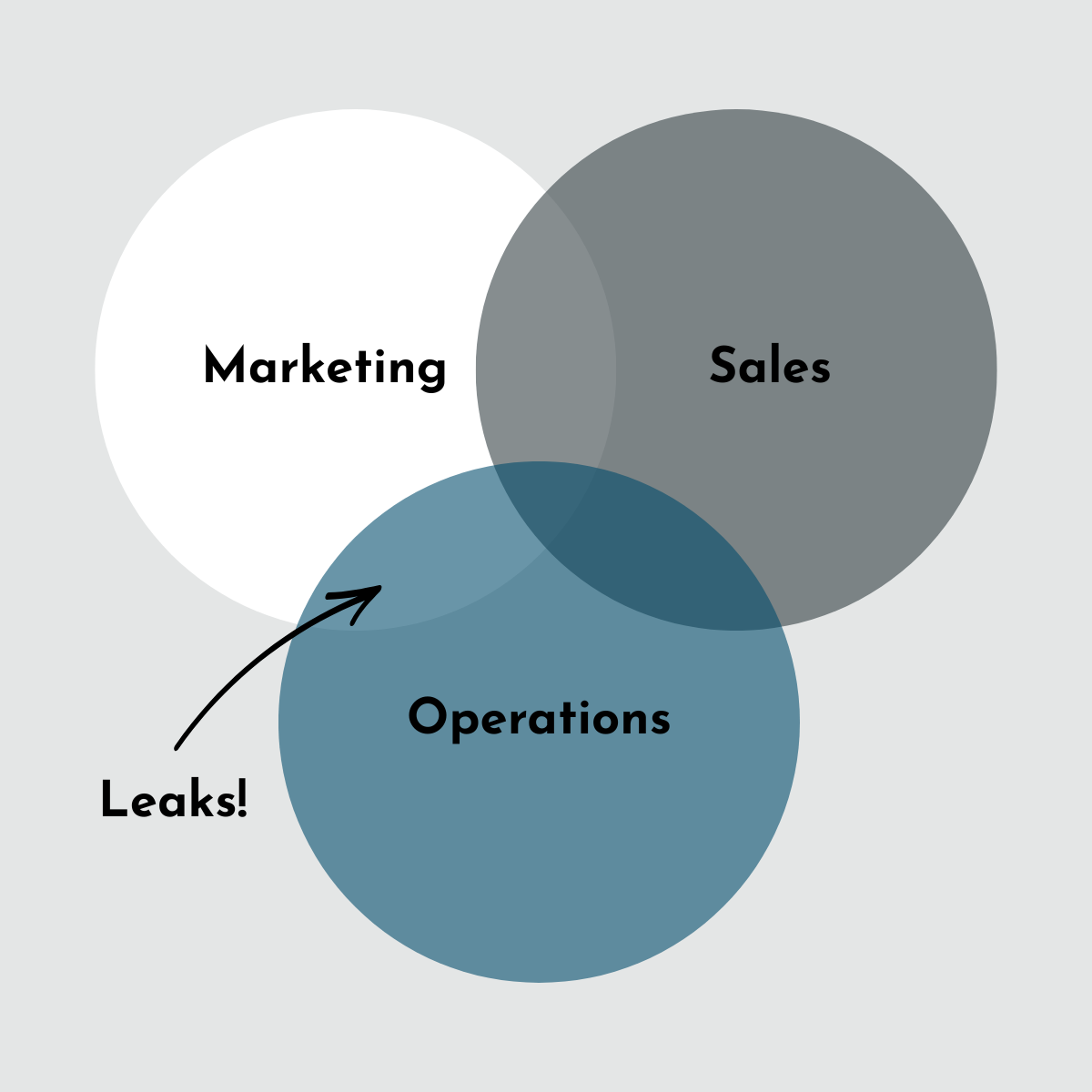
The way I find these leaks is with a Venn diagram. Marketing in one circle. Sales in another. And operations in a third.
Most firms optimize one circle at a time (better ads, sharper closing scripts, a cleaner website) and wonder why the total still doesn't add up. But the leaks live in the overlaps, and so does the fix:
Marketing meets sales: unqualified traffic lands on the calendar because the keywords are pulling the wrong crowd. A targeting problem you only see when sales tells marketing who's actually showing up.
Marketing meets operations: the "Book a Call" bottleneck, with no way to capture and nurture the not-yet-ready.
Sales meets operations: networking contacts and warm intros that never make it into the CRM, so the follow-up never happens.
None of these are visible from inside a single circle. All of them are obvious the moment you look at the whole system. And that’s what I do.
The real problem isn't a tactic. It's ownership.
Notice what every one of those leaks has in common. It isn't a bad ad or a weak script. It's that the space between marketing and sales belongs to no one. Marketing assumes sales has it. Sales assumes marketing has it. And the lead in the middle, the one you paid to attract, quietly falls through.
You can't fix a gap that isn't anyone's job.
What it costs to leave it alone
Here's the hard part. Nothing dramatic happens. There's no crash, no single failure to point at. The handoff just keeps leaking, quietly, while you keep funding the top of the funnel to make up for it.
So you spend more to drive traffic to a door people are already knocking on. The curious-but-not-ready leads, the ones who might have been your best clients, drift to the competitor who followed up. Growth stays flat no matter how much you pour in. And the whole time it looks like a marketing problem, so you keep trying to solve it with more marketing.
The longer the gap goes unowned, the more it costs. Not in one visible line item, but in the revenue that was always within reach and never converted.
What changes with a marketing leader
This is the work I love. Someone has to look at all three circles, marketing, sales, and operations, and own the seams between them. Not more tactics. A person accountable for the whole journey, from the first click to the signed client.
That's what a fractional marketing leader does. I map where your leads actually go, find where they're slipping, and build the connective tissue so marketing and sales stop handing off a baton and start running as one engine. The phone is already ringing. The work is to stop losing what it brings in.
Let's look at your handoff
If any of this is hitting close to home, I'd love to talk about what it looks like in your firm specifically. Reach out, or book a consult, and we'll find the gap together.
Amanda
Amanda Berlin is a Fractional CMO who partners with financial advisory and professional services firms to transform their marketing capabilities into measurable drivers of growth. Through her strategic marketing planning process, she helps firms establish systems that create consistent, qualified leads while minimizing the operational burden on the leadership team.
